
Since a few years we’ve been designing and producing writing fonts, fonts which have their writing dynamics included in the font file. As these are something new in the industry, some people wonder what they are and how they function.
In May 2023, when we released the type family Scribo, we gave a lecture at the ATypI conference in Paris. Because the starting point for Scribo was to design the dynamics of handwriting, we took the opportunity of this lecture to explain what details are involved in the making of writing fonts. For example: new terminology is required once type is designed in time, because how fast is a “default” speed and is there a unit to describe this? There are a lot of conventions for relations in space (like kerning), but there is a need for similar terminology for relations in time (like tuning). This, and much more details, are explained in this lecture, which of course also includes live action writing for an empirical experience.
Often these lectures are only accessible for registered attendees, but we’re happy that a recording of this lecture is now available to anybody.
This autumn we’ll make a small tour across France, Germany and Switzerland with some lectures and workshops at educational institutes, festivals and symposiums. We’re looking forward to meet old but also lots of new friends, so hopefully we’ll see you on one of these occasions.
5 October — Nancy
Lecture “Beyond Unicode” at Atelier national de recherche typographique, Nancy France.
5-6 October — Nancy
Two-day workshop “Beyond Unicode” at Atelier national de recherche typographique, Nancy, France.
9 October — Strasbourg
Lecture “From Chirography to Grammatography” at Formats Festival in Strasbourg, France.
11 October — Zürich
Lecture “Deep Writing” at Zürcher Hochschule der Künste, Zürich, Switzerland.
13 October — Basel
Lecture “Is it U+2047?” at Hochschule für Gestaltung und Kunst Basel HGK, in Basel, Switzerland.
6-10 November – Geneva
Five-day typeworkshop “Signature moves” at HEAD, Geneva, Switzerland
15 November — Paris
Lecture “The coding hand, encoding the hand” at Font and Faces #10, Campus Fonderie de l’Image, Bagnolet, Paris, France.
18 November — Munich
Lecture “Look backward, write forward” at Dynamic Font Day, Munich Germany.
21 November — Stuttgart
Lecture “Vorwärts schreiben, rückwärts schauen” at Merz Akademie, Stuttgart, Germany.
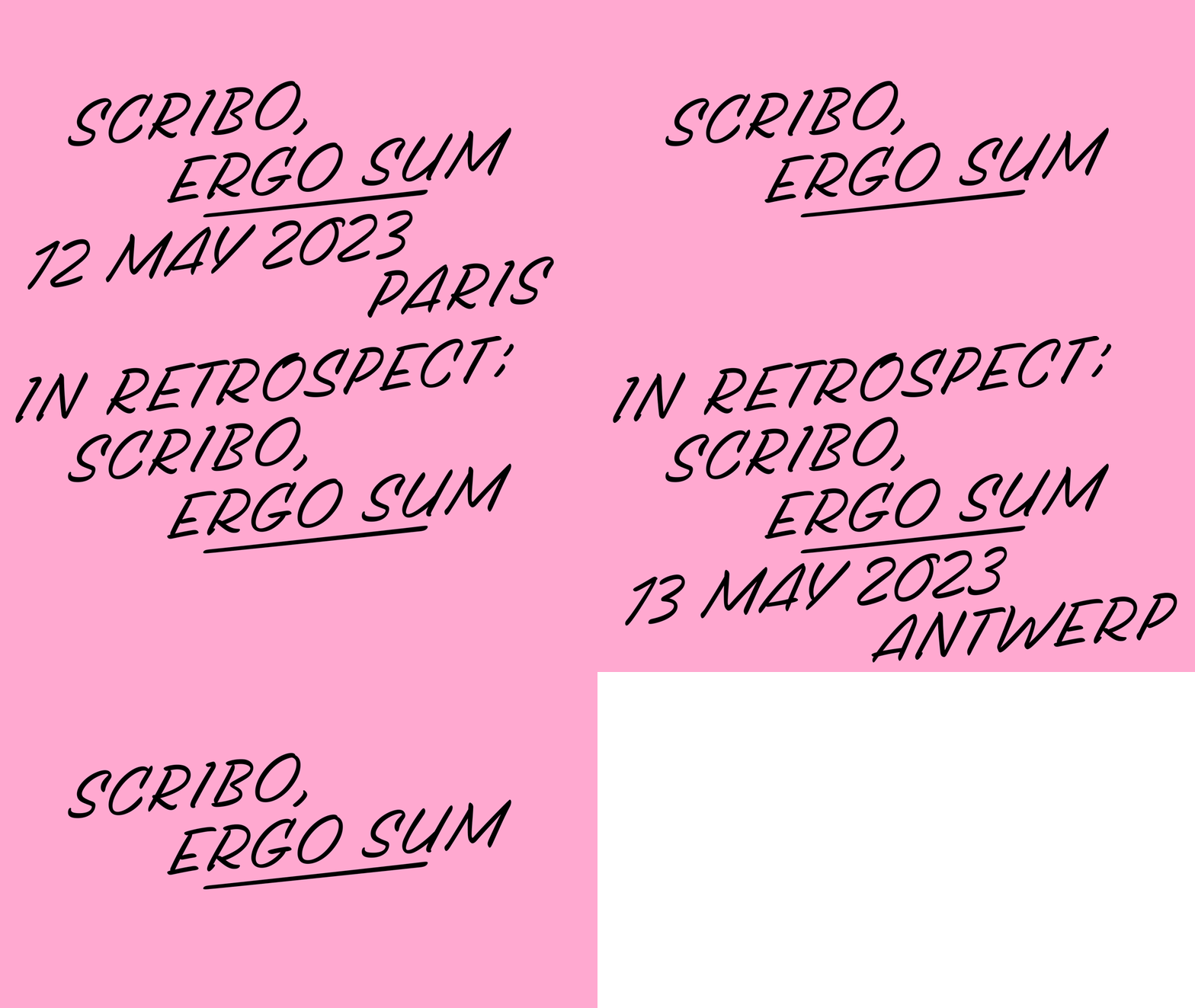
Although through writing someone can assert their existence, we are not publishing a book but instead will soon give two lectures around the theme “Scribo, ergo sum”. These lectures will take place on Friday 12 May 2023 in Paris at the ATypI conference, and on Saturday 13 May 2023 in Antwerp at the TypoCafé.
12 May 2023 — Paris
The first lecture in Paris is titled “Scribo, ergo sum” and trades on writing anno 2023, what new possibilities the combination of writing by hand and by computer offers, and also what new unexplored territory lies there, and we touch on a lack of terminology to describe that new territory.
atypi.org
13 May 2023 — Antwerp
The second lecture in Antwerp is one day later, and is logically titled “In retrospect: Scribo, ergo sum”. This will probably be our most topical lecture ever, as in it we look back at what we presented just one day earlier in Paris. We will try to already reflect cautiously at this event organised by Initiaal, alumni of the Plantin Institute of Typography.
initiaal.be
Saturday 15 Oct 2022 we’ll give a talk titled Rule of Three at the InScript festival, a 5-day festival on the overlap of typography and technology. As the organisation puts it: “The five-day festival will showcase portfolios and behind-the-scenes among top design practitioners working with artificial intelligence, augmented and virtual realities, dimensional typography, creative coding, physical computing, and innovative use of traditional craft.” All lectures will be streamed online, so you can follow this inaugural event from anywhere in the world. In case you want to be inspired by 30+ speakers in the world of contemporary experimental type, sign up at inscript.tf
▶ Rule of Three
Lecture by Underware at InScript
Saturday 15 October 2022
NY 11:30–12:10
Amsterdam 17:30–18:10
Shanghai 23:30–00:10
Register & watch online at inscript.tf
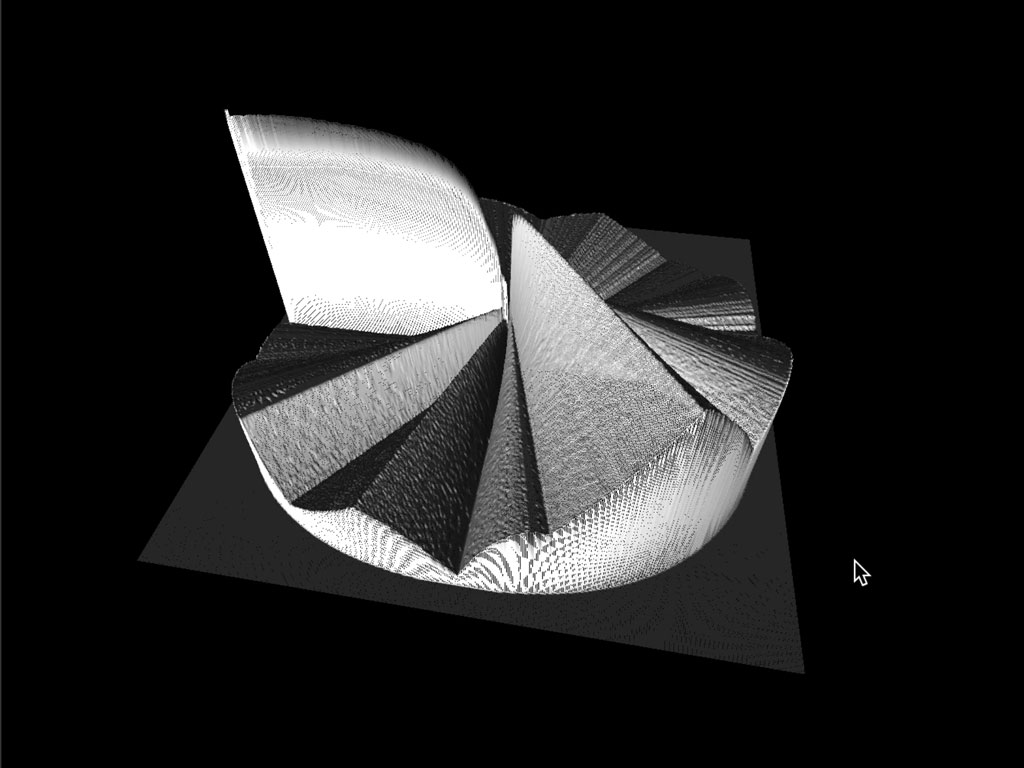
Instead of presenting our recent findings and points of views in a lecture, we’ve used the opportunity of giving a lecture to develop new findings and points of views in recent years. A satisfactory turnaround in approach. Contemporary technological developments not only affect the design process (not only of letters, but of any design process), but also have an impact on how letters are used, and what a letter is. A lecture is a good moment to reflect on this, by developing new thoughts, making new demos, sketching new ideas, or making new designs.
Coming Thursday 7 July 2022 we’ll give a lecture at the International Conference on Typography and Visual Communication in Thessaloniki, Greece. This time we’re gonna explore what’s inside the letter.
.
Thursday 10 March 2022 we’ll give a lecture at the Printemps de la Typographie, organised by l’école Estienne in Paris. Those who can remember previous editions, that’s before the pandemic, will remember we gave a lecture a the last 2 editions of this one day seminar. As usual we only understand what we’re doing while we’re doing it, and we came to the conclusion that we’ve actually been telling one long story at the Printemps de la Typographie, started in 2019, continued in 2020, and we’re gonna finish that story in 2022 with the lecture ‘Homo Scriptus’. Therefore it would be a pleasure to see you coming Thursday in Paris at the final episode of our Pen Triptych. Other lectures by Emmanuël Souchier, Charles Gautier, Gabriele Cepulyte, Jean Alessandrini and Olivier Nineuil, Sophie Cure, Esther Szac & André Baldinger.
Tickets and more info here.
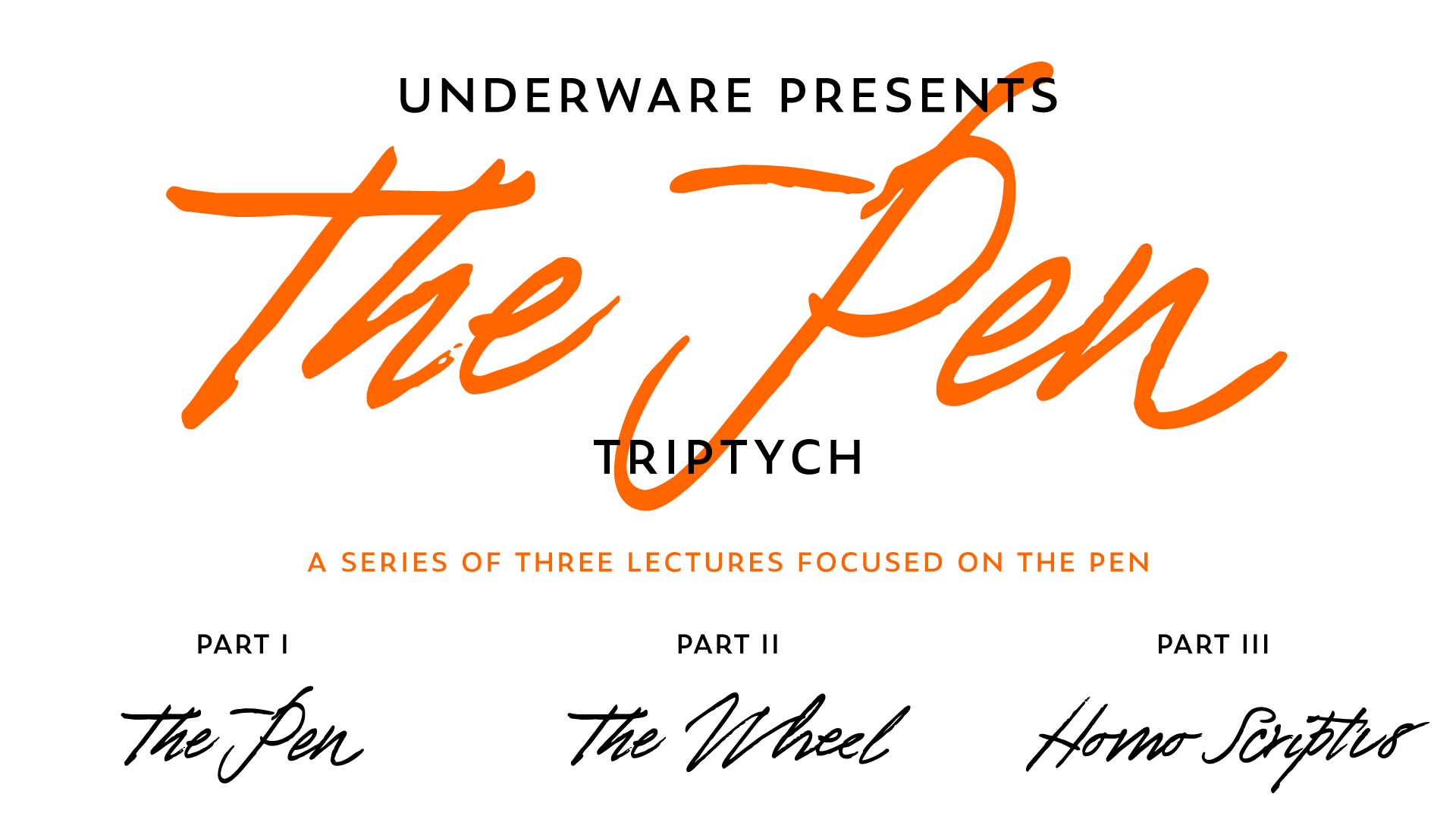
Coming Friday, 6 Nov, we’ll start something new. Inspired by our Berlin Triptych (2017-2019), a series of three lectures in which every lecture continued where the previous lecture had ended, we’re gonna start a new series of 3 joined lectures which tell one longer story. But where the Berlin Triptych (I, II, III) was focused on the subject of letters, this new triptych explores the pen.
The first part of this new triptych, named “The Pen”, will be presented this week in Mexico at the Tipografía México conference, and can be watched online for free. The second part (“The Wheel”) and third part (“Homo Scriptus”) of the triptych are still to be announced.
Fri 6 Nov. 2020
Underware lecture: The Pen
(The Pen Triptych part I)
🇲🇽 12:00 (CST) Mexico 😎
🗽 13:00 (EST) New York ☀️
🇪🇺 19:00 (CET) Berlin 🌧
🇮🇳 23:30 (IST) Mumbai 🌛
🇯🇵 03:00 (JST) Tokyo 🌚
Broadcasted for free
👉 tipografiamexico.com
15-minute introduction to grammatography
If you’ve never heard about grammatography, but if you are interested in writing, fonts, scripts, or typography, then this presentation about a new way of writing is for you.
This 15-minute introduction to grammatography was broadcast 25 Sept 2020 during the Typewknd-conference, and is now available for anybody to watch. The video is accompanied by a quick write-up for even better understanding of this new subject. For 🤯 check the complete case study Grammatography!
(ps. Original trailer here)
On Friday 8 November 2019 we’re gonna complete our Berlin Triptych, with a lecture at Creative Mornings in Berlin. In the past 2 years we gave a lecture once a year in Berlin which was part of a triptych. What started in 2017 with the first lecture “If you want something new, you have to stop doing something old”, was followed by the second lecture in 2018 titled “Export Future”. The triptych will now be completed with the third and last lecture in this series titled “Into the Void”.
Three lectures filled with developments, ideas, concepts, approaches, sketches, thoughts, perspectives, and mostly questions, in this case focused on letters, but they apply to other subjects too. During the first 2 lectures of this Berlin Triptych various typographic ideas – for example Font Fiction, Higher Order Interpolation or the SuperFont™ – were introduced. Next week Friday we gonna see where this journey will end up.
If you missed out on the first 2 lectures, don’t worry. You can either still do your homework and watch them online before you attend (see links above), or completely surprise yourself and attend the third lecture without any previous knowledge. We’ll leave that up to you.
Into the Void
Underware’s Berlin Triptych III
Venue: Creative Mornings Berlin
Date: 8 November; 08:30 o’clock
Location: Native Instruments, Schlesische Str. 29-30, Berlin
Tickets will be on sale from Monday 4 November 10:00 o’clock at the Creative Mornings website: Register.
If you’re in the mood to join us on our typographic trip, we would enjoy seeing you in Berlin next week. (And we would like to thank Jürgen Siebert for enabling Underware’s Berlin Triptych)
We’ve just returned from our Right To Write Tour in Japan. Besides of an exhibition at Print Gallery in Tokyo, and a workshop at the Temple University in Tokyo, we gave 4 lectures in Tokyo and Osaka in which we presented grammatography, and introduced Grammato.com. Instant updates during the tour don’t happen on this blog, but on our Twitter or Instagram account. So follow those in case you want to see more snippets. However, for those who are curious to know more about grammatography, the video of our talk titled Grammatography at the ATypI conference in Tokyo is now online. Featuring live writing, as future is written. Enjoy! (ps. At the interpreter’s request we tried to speak slowly…)